







Beyond the Grind: 5 Strategic Levers to Scale Your IT & Tech Business Revenue (Without Adding More Hours)
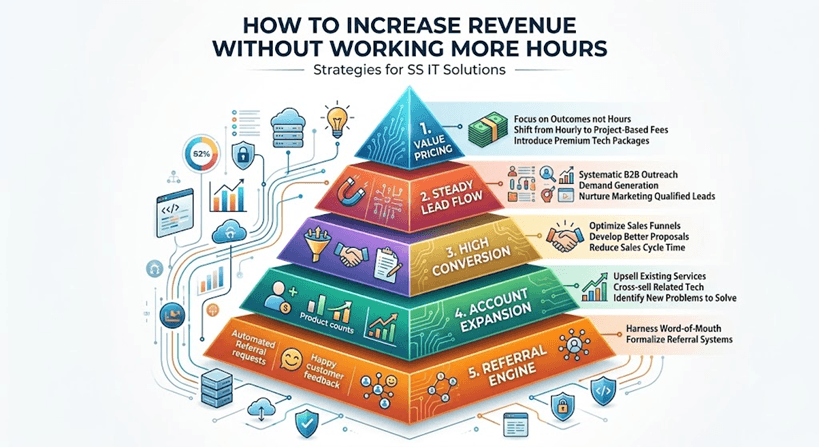
Most founders, tech leaders, and service providers share a common, deeply ingrained belief: If I want to grow my revenue, I need to work more hours.
It sounds perfectly logical on paper. More hours equals more output, which surely equals more clients and more revenue. So, you stretch your days from 8 hours to 12. Your team burns the midnight oil. You sacrifice your weekends to keep projects moving.
But instead of seeing an explosion in profitability, you hit a wall. Your pipeline stalls, your margins shrink, and the shadow of burnout looms over your entire organization.
The truth is, working more hours is an inefficient way to make more money.
When you rely solely on adding hours to scale, you are treating a symptom rather than addressing the core constraints of your business architecture. If your offer structure is misaligned, your pricing model is outdated, your messaging is generic, or your pipeline lacks predictability, working harder only accelerates your path to burnout.
At SS IT Solutions, we help businesses leverage technology, automation, and optimized workflows to break free from this time-for-money trap. Before you try to grind it out, look at these five strategic levers to build sustainable, scalable revenue growth.
1. Value-Based Pricing: Charge What You are Worth
Most IT and service companies undercharge by default because they price based on inputs (hours worked) rather than outcomes (value delivered).
- The Shift: A premium price tag signals premium quality. Conversely, keeping your prices artificially low attracts high-maintenance, low-budget clients who drain your team’s internal resources.
- Action Step: Try adding 20% to your next corporate tech solutions quote. Focus your pitch entirely on the financial or operational impact your solution delivers, not the number of software development hours it takes to build.
2. Architect a Predictable, Tech-Driven Lead Flow
Relying on sporadic word-of-mouth or juggling five different unoptimized marketing strategies will split your focus. One highly efficient, fully operational channel beats five channels you only dabble in.
- The Shift: You don’t necessarily need a massive ad budget to populate your pipeline. What you need is consistency and the right digital infrastructure to streamline outreach.
- Action Step: Commit to reaching out to at least one highly qualified ideal prospect every single day. Utilize CRM tools and smart data scraping solutions to ensure your business development team is targeting the right decision-makers with minimal manual overhead.
3. Optimize the Conversion Funnel
A massive volume of inbound leads means nothing if your sales cycle is leaky. Most leads never convert into paying clients because businesses treat sales like a pitch rather than a diagnostic process.
- The Shift: Stop acting like a vendor pushing a product; start acting like a strategic consultant solving a critical technical or operational bottleneck. Small incremental improvements in your conversion rate instantly translate into pure revenue.
- Action Step: Audit your discovery call framework. Ask deeper, diagnostic questions to uncover the prospect’s core organizational pain points, then tailor your proposal to show exactly how your software or IT services resolve those specific vulnerabilities.
4. Systematize Client Retention and Account Expansion
It is far more cost-effective to grow an existing account than it is to acquire a brand-new one. Data shows that a mere 5% increase in customer retention can boost overall business profitability by 25% to 95%.
- The Shift: Once a client trusts your engineering or consulting capabilities, the friction to sell to them again is practically zero. Loyal clients form the predictable bedrock of your MRR (Monthly Recurring Revenue).
- Action Step: Proactively review your current client roster. Identify one additional operational challenge they are facing that your extended tech suites can solve, and present it as an integrated account expansion roadmap.
5. Build an Intentional Referral Engine
Referral leads close significantly faster and have a much higher lifetime value than cold outreach because the element of trust is pre-established. Yet, most companies leave referrals completely to chance.
- The Shift: Turn referral generation from a passive “hope-of-mouth” strategy into a systematized post-delivery workflow.
- Action Step: Don’t wait around for clients to remember you. Make it a standard practice to ask your happiest clients for a warm introduction to one peer in their professional network immediately following a successful project milestone or system launch.
Breaking the Constraint
If your business growth has plateaued, adding more hours to the calendar will only mask the real structural constraints. True scalability comes from pricing for value, automating your workflows, optimizing your pipelines, and treating client relationships as long-term assets.
Ready to modernize your business infrastructure, eliminate manual bottlenecks, and scale your technology operations smoothly? Let’s build the framework your company needs to grow efficiently.
👉 Partner with SS IT Solutions today to optimize your digital systems.

